
How can the environmental footprint of rail HVAC systems be reduced while improving their performance and maintenance? This is the goal of the PROPAIR project, to which Cetim is contributing alongside Wabtec, Devismes and RATP Dev. Presented at InnoTrans 2026, on Cetim booth 270 Hall 11.2, the project illustrates Cetim’s ability to support rail innovation from design through to validation under real operating conditions.
An innovation supporting the decarbonisation of rail transport
Heating and air conditioning account for more than 30% of a tram’s energy consumption, making them a major area for improvement for public transport operators. To address this challenge, the PROPAIR project partners are developing a new generation of HVAC systems using the natural refrigerant R290 (propane). This technology aims to significantly reduce greenhouse gas emissions while cutting energy consumption by at least 20% compared with conventional systems. Beyond the expected energy savings, using R290 substantially reduces the system’s climate impact because its global warming potential is far lower than that of the refrigerants traditionally used in the sector.
The prototype will be put into service and tested in late September 2026 on the Brest tram network, made available by RATP Dev for evaluation under real operating conditions.
Support from R&D through to industrial validation
Within the consortium, Cetim is helping the partners manage the technical risks associated with introducing this new technology into the particularly demanding rail environment. To meet this challenge, Cetim is drawing on a broad range of capabilities covering the entire development cycle:
- life-cycle assessment and ecodesign;
- modelling and numerical simulation of HVAC systems;
- development of digital twins;
- artificial intelligence and predictive maintenance;
- metal additive manufacturing for innovative heat exchangers;
- vibration, shock and electromagnetic compatibility testing;
- support for safety and validation studies.
This multidisciplinary approach illustrates Cetim’s ability to combine materials, processes, simulation, testing and digital technologies to support industrial innovation.
From AI to additive manufacturing: technologies driving performance
The innovations developed as part of PROPAIR include heat exchangers optimised through metal additive manufacturing, as well as a digital twin combining field data, physics-based models and artificial intelligence. This approach enables predictive maintenance capable of anticipating failures, reducing downtime and improving rolling stock availability.
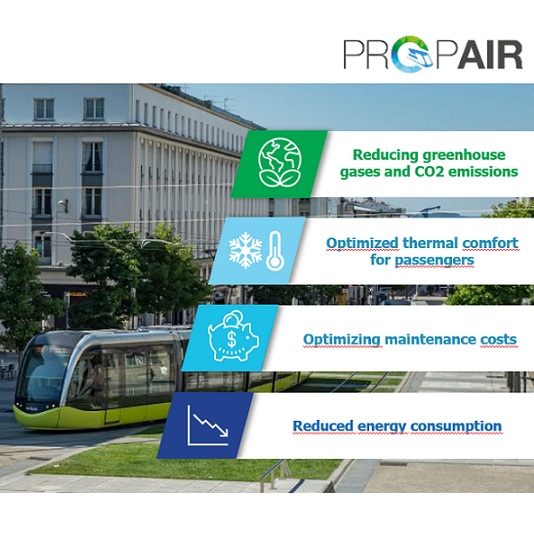
Beyond its technological advances, PROPAIR therefore delivers tangible benefits across the entire rail ecosystem: lower energy consumption and operating costs for operators, improved equipment reliability and passenger comfort, while contributing to the competitiveness and decarbonisation of the European rail industry.
Meet Cetim at InnoTrans 2026: from the PROPAIR project to the rail innovations of tomorrow
PROPAIR illustrates the ability of Cetim and the project partners to support the development of more sustainable, reliable and efficient rail solutions. By drawing on its multidisciplinary expertise, Cetim helps turn promising innovations into operational solutions that meet the industry’s requirements.
Do you need to qualify new equipment, reduce technical risks before industrialisation, validate an innovative material or process, or integrate artificial intelligence into your systems? Cetim’s experts support you at every stage, from R&D through to industrial validation, helping you reduce technical risks and accelerate development.
Meet us at InnoTrans 2026 in Berlin from 22 to 25 September at Stand 270, Hall 11.2, and discover how the expertise deployed in projects such as PROPAIR can help de-risk your developments, accelerate validation and strengthen the competitiveness of your rail innovations.
“This project was funded by the French State and the European Union – NextGenerationEU, as part of the France 2030 plan.”